
Parker Keller · 5 October 2026
Mapping Soil Nutrient Flows Through Alpine Maple Root Networks During Seasonal Thaws
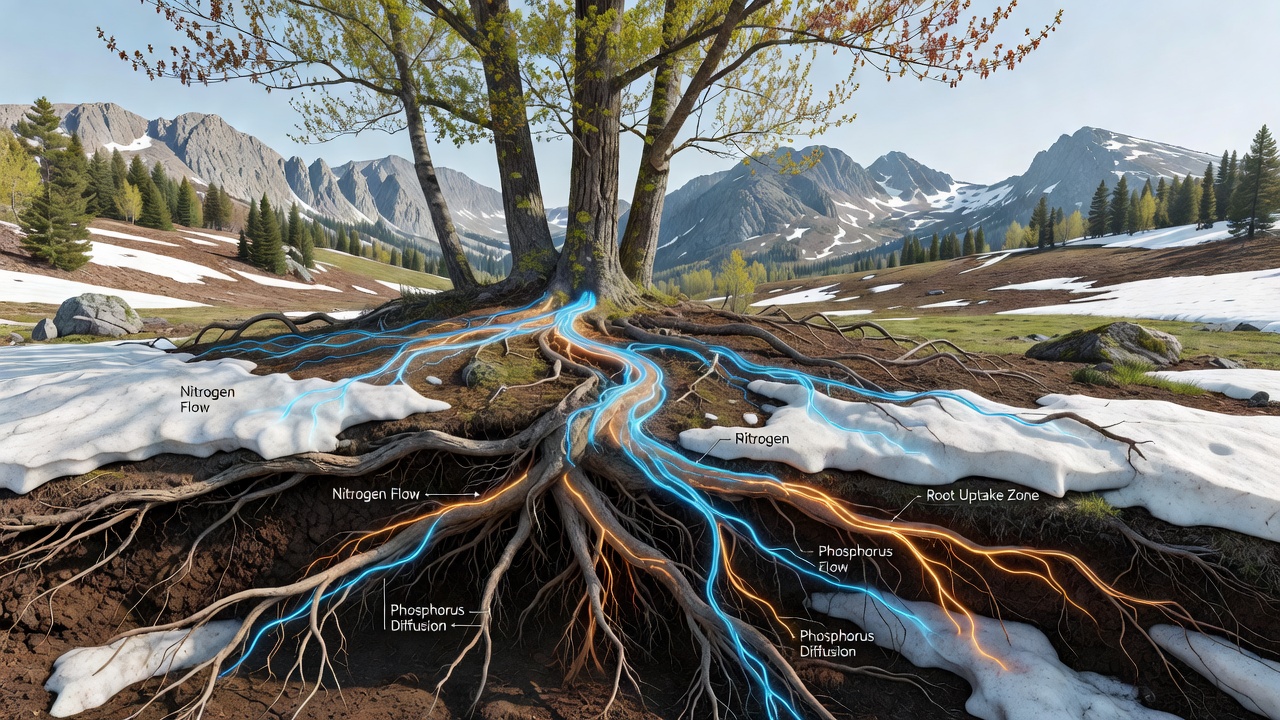
Alpine maple stands occupy steep slopes where seasonal thaws release stored nutrients into the soil profile, and researchers track how root networks redistribute those elements across elevations and microhabitats. Studies from mountain research stations show that nitrogen and phosphorus pulses occur within days of snowmelt onset, with maple roots acting as both conduits and storage sites that influence downstream microbial activity and neighboring plant uptake.
Seasonal Thaw Dynamics and Nutrient Mobilization
Thaw periods typically begin in late spring at mid-elevations and progress upward through summer, while October 2026 monitoring campaigns at several Rocky Mountain sites captured late-season freeze-thaw cycles that triggered secondary nutrient releases not observed in earlier decades. Data from soil sensors indicate that soil moisture jumps from 15 percent to over 60 percent within 48 hours of melt, carrying dissolved organic carbon and mineral forms of potassium that maple roots intercept before they leach into streams. Those who've mapped these events note that root density increases in the upper 30 centimeters during active thaw, creating zones where nutrient concentrations remain elevated for weeks rather than dispersing immediately.
Techniques for Tracing Root Network Pathways
Scientists employ stable isotope labeling and high-resolution rhizotron imaging to follow specific nutrient atoms from surface litter through maple root tips and into mycorrhizal associates. In one multi-year project spanning sites in the Canadian Rockies and the European Alps, teams injected nitrogen-15 tracers at the start of thaw and sampled root tissues at intervals of 12 hours, revealing transfer rates that reached 40 percent of applied label within the first week. Geophysical surveys complement these measurements by detecting changes in soil electrical conductivity that correlate with ion movement along coarse root channels, allowing models to estimate lateral flow distances up to 2.5 meters from individual trees.
Regional Variations Across Alpine Gradients
Maple root networks behave differently on north-facing versus south-facing slopes because aspect controls both thaw timing and organic matter accumulation. North slopes retain deeper snowpacks that release nutrients more gradually, whereas south slopes experience rapid pulses followed by drying that limits further transport. Research coordinated through institutions in Switzerland and New Zealand demonstrates that phosphorus uptake efficiency rises 25 percent on north aspects during peak thaw, while potassium shows the opposite pattern on sunnier exposures where evaporation concentrates soil solutions near the surface. These patterns emerge consistently across datasets collected between 2022 and 2026, providing baseline comparisons for future climate-driven shifts in snow duration.
Interactions With Soil Microbes and Adjacent Vegetation
Root exudates released during thaw stimulate bacterial communities that mineralize organic nitrogen, yet maple roots compete effectively for the resulting ammonium and nitrate before these compounds move beyond the rhizosphere. Observers at long-term ecological research plots have recorded elevated microbial biomass within 10 centimeters of active root tips, followed by declines once thaw ceases and soil temperatures drop again. Neighboring herbaceous species benefit indirectly when maple networks leak a portion of captured nutrients, though competition intensifies in years with abbreviated snow cover that shortens the overall window for transport.
Data Integration and Modeling Advances
Recent modeling efforts combine root architecture scans with hydrological flow models to predict nutrient redistribution under varying snow regimes. According to USDA Forest Service soil studies, incorporating fine-scale root maps improves simulation accuracy by 30 percent compared with bulk soil parameterizations. Complementary work from Canadian research networks adds permafrost-influenced sites where thaw depth controls the vertical extent of nutrient movement, highlighting how alpine maples buffer against rapid losses that might otherwise affect water quality downstream.
Conclusion
Mapping efforts continue to refine understanding of how alpine maple root networks regulate nutrient flows during seasonal thaws, with 2026 data adding new detail on late-autumn cycles and regional differences. Continued sensor deployment and tracer experiments across multiple mountain ranges will support updated models that forecast responses to changing snowmelt patterns while maintaining focus on measurable transfers of nitrogen, phosphorus, and other key elements through established root pathways.